
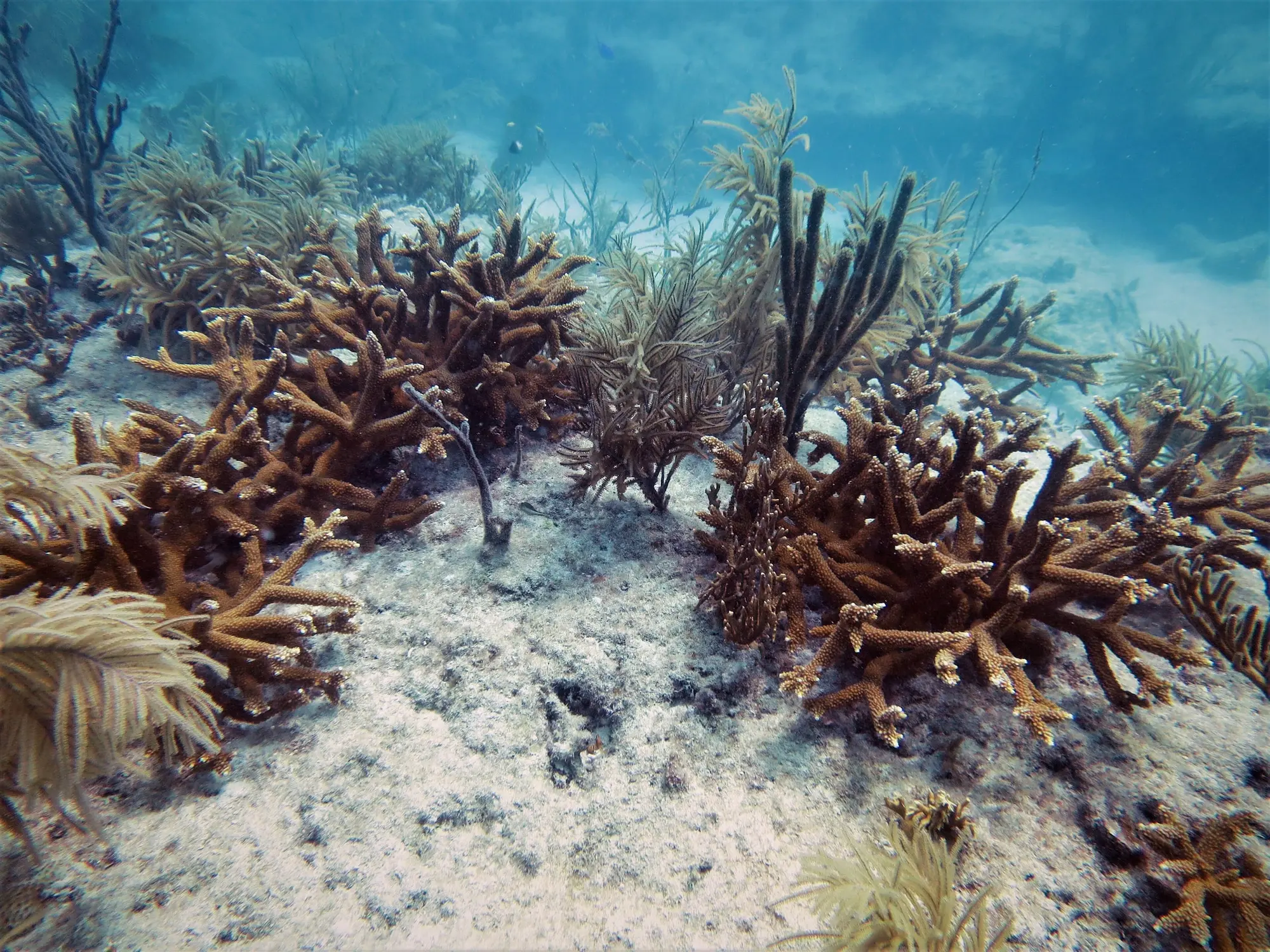
_at_Looe_Key_reef_(106714).jpg)
The Florida Keys reef is the only living coral barrier reef in the continental United States, it sits inside a national marine sanctuary, and off Key West it is 6 to 8 miles offshore. That last part is the one that reorganizes people’s plans.
You need a boat
Both of our beach pages say a version of this and it is worth stating once properly: Key West’s beaches are swimming beaches. Fort Zachary Taylor has the best snorkeling on the island, which is faint praise. Smathers has none worth the name. The reef is out there, and the way to it is a boat.
A trip is roughly three hours and usually two stops. That is the shape of the afternoon, and on a cruise ship day it is the best possible use of one.
Which reef
The captain chooses on the morning, from the wind and the sea state. The choice is among the protected reefs off the island. From the sanctuary’s own boundary coordinates in the federal regulations, measured from Key West’s south shore:
| Reef | Zone | Distance offshore |
|---|---|---|
| Eastern Dry Rocks | Sanctuary preservation area | About 6 miles |
| Rock Key | Sanctuary preservation area | About 7 miles |
| Sand Key | Sanctuary preservation area | About 7 to 8 miles |
| Western Sambo | Ecological reserve, off Boca Chica to the east | Runs from about 4 to 7 miles out |
Those are the nearest named reefs. Looe Key, the one people talk about in the Lower Keys, is more than 20 miles east of Key West.
The rules, which are federal and not advisory
These apply sanctuary-wide, everywhere the boat can take you:
“Removing, injuring, or possessing coral or live rock (substrate with living organisms attached)”
“Operating a vessel in such a manner as to strike or otherwise injure coral, seagrass, or other immobile organisms attached to the seabed, or cause prop scarring”
“Having a vessel anchored on living coral”
Inside the protected zones — which is where any decent operator takes you — it goes further:
“Touching or standing on living or dead coral”
Dead coral too. That surprises people, and the reason is that dead coral skeleton is the structure everything else regrows on.
The one you should know as a swimmer
“Operating a vessel at more than idle speed/no wake within 300 feet (100 yards) of a ‘divers down’ flag”
The dive flag on your boat creates a 300-foot bubble that other vessels must crawl through. That is your protection, and it is why you stay near the boat rather than drifting off to the interesting-looking thing a quarter mile away.
How you know where you are
This is the fact that is actually useful once you are on the water:
“Sanctuary preservation areas and conservation areas are marked by 30-inch round yellow buoys. Tortugas North and South conservation areas are not marked. Wildlife management areas are marked by white and orange information/regulatory cylindrical spar buoys and signs.”
Yellow round buoy: you are in a preservation or conservation area and the stricter rules apply. White and orange cylinder: wildlife management area, which may be idle-speed, no-motor, no-anchor or no-entry.
The zoning is not new:
“Florida Keys National Marine Sanctuary established the nation’s first comprehensive network of marine zones in 1997 after years of planning, design, and public input.”
The 2027 anchoring change, and why it skips Key West’s reefs
Tucked into the prohibition list for habitat conservation areas, sanctuary preservation areas and nursery restoration areas:
“Anchoring (this prohibition will not take effect until 2027)”
The sanctuary’s page on its preservation areas says who that reaches:
“In 2027, anchoring of any kind will be prohibited in SPAs except for Hen and Chickens, Cheeca Rocks, Newfound Harbor Key, Eastern Dry Rocks, Rock Key, and Sand Key.”
The last three are the Key West reefs. So for the trips on this page the 2027 change is smaller than it sounds: anchoring on coral, and anchoring when a mooring buoy is free, are already banned at all three and stay banned, and the total ban is not coming to them. It is coming to most of the preservation areas up the Keys.
How to tell a snorkel trip from a fishing trip with a swim stop
A genuinely useful tell:
“Catch and release fishing by trolling is allowed in Conch Reef, Alligator Reef, Sombrero Reef, and Sand Key SPAs only.”
If a listing is vague about whether it is a snorkel trip or a fishing charter with a snorkel stop, that is a different product with a different day attached to it. Read what the boat is for. If it is fishing you are after, the fishing charters page sorts the party boats from the private boats and says which reefs are closed to fishing.
Paddle trips reach places motorboats cannot
“Wildlife management areas may be designated ‘idle speed no-wake,’ ‘no motor,’ ‘no anchor by vessels under 164 feet (50 meters),’ or ‘no-entry’.”
“‘no motor’ zone: prohibited from using internal combustion motors or engines for any purposes. A vessel with an internal combustion motor or engine may access a ‘no motor’ zone only through the use of a push pole, paddle, sail, electric motor or similar means of propulsion.”
Which is the real argument for a kayak, paddleboard or electric-boat trip into the backcountry over a conventional motorboat: there is water it can legally enter that a motorboat cannot. Those are shallow-water trips through the mangroves and flats rather than reef trips, and the reef trip below is a sailboat going out to the reef line. The same zones are why every jet ski here goes out behind a guide; the jet ski and parasail page has the rules and the ages.
Sunscreen, and the ban that is not
You will read that Key West banned certain sunscreens. Florida law settled that in 2020:
“Notwithstanding any other law or local ordinance or regulation to the contrary, the regulation of over-the-counter proprietary drugs and cosmetics is expressly preempted to the state.”
That is Fla. Stat. § 499.002(7), and sunscreen is sold as an over-the-counter drug, so no local sunscreen rule can be enforced in Key West. Over a living reef, a mineral sunscreen is still the better choice, and so is a rash guard.
The free, dry version
The Eco-Discovery Center, at 35 East Quay Road on the way to Fort Zach, is NOAA’s own sanctuary visitor center, and it is free. For now it is shut:
“The NOAA Florida Keys Eco-Discovery Center is temporarily closed while NOAA evaluates findings from a recent structural assessment of the facility.”
The work is on the roof, and NOAA gives no reopening date. Its 360-degree virtual tour of the sanctuary and the center is online in the meantime. Open, the center kept Wednesday to Saturday, 9 a.m. to 4 p.m., and it pairs naturally with a beach day at Fort Zach.
What we would book
The reef trip we list is $79 for about three hours, rated 4.7 across 250 reviews, with free cancellation up to 24 hours before departure.
That cancellation term is worth more than it looks in a place where the weather decides your day. Book it early for a middle day of your trip, and if the wind comes up you have lost nothing.


