
.jpg)
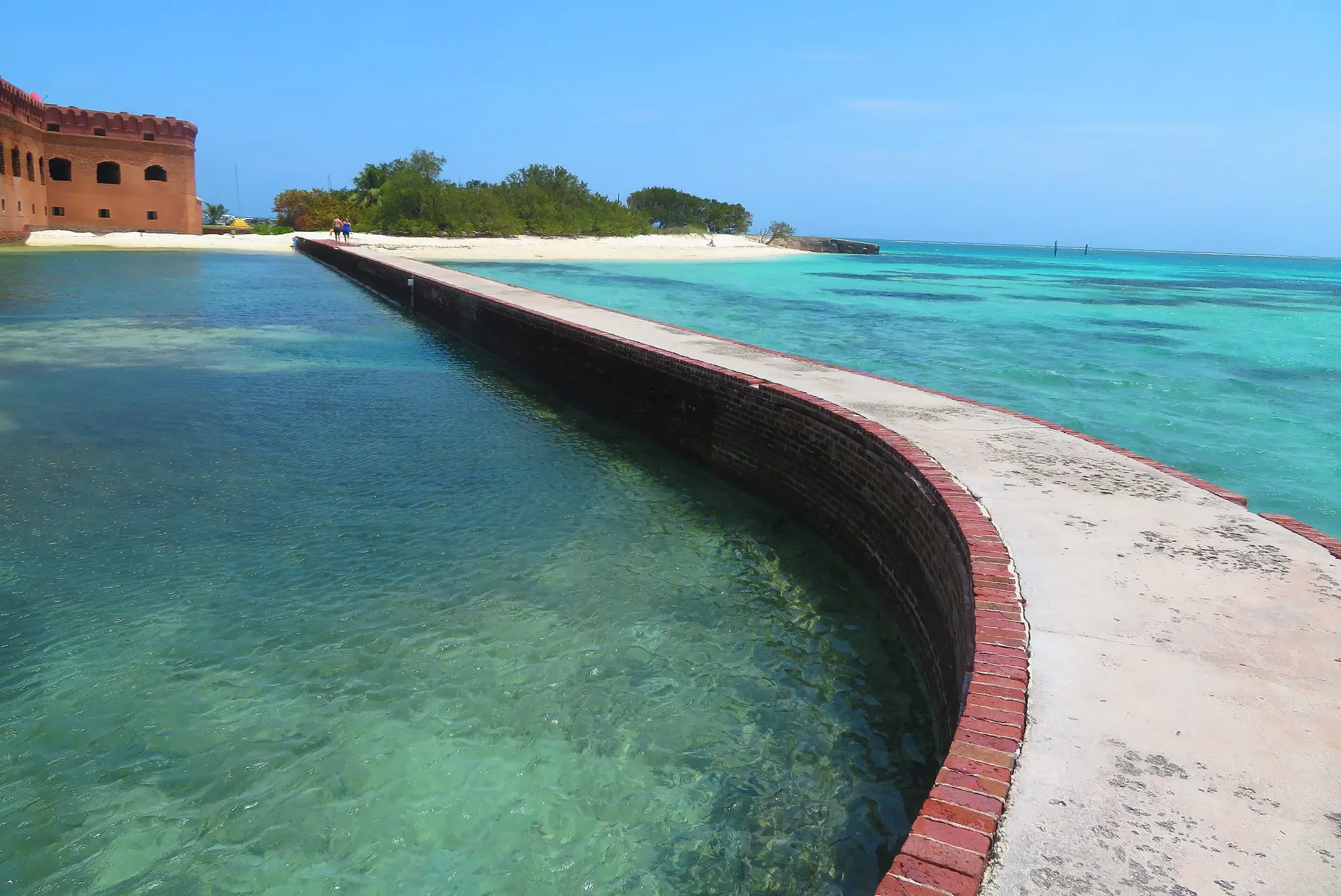
Camping at Dry Tortugas means Garden Key, the island Fort Jefferson stands on, and nowhere else in the park. The Garden Key campground is primitive and a short walk from the dock: eight first-come sites, a group site and a grassy overflow area, with no water, no power and no supplies for sale. Campers come out on the Yankee Freedom ferry, on their own boat or with one of the tour operators the Park Service permits.
It is the best night anywhere near Key West and one of the most awkward to arrange, and most of the awkwardness is the ferry.
Camping reservations: how to get a camper seat
Ten campers a day is the Yankee Freedom’s whole allowance, and that, not the campground, is what sells out. The ferry seat is the reservation, and camper seats are booked on the Yankee Freedom’s own camping reservation calendar, on its website, drytortugas.com.
When the seats open. The operator releases camper seats a month at a time, on the first weekday of each month, between 8 a.m. and 5 p.m. Eastern. Its own example is the one to count from: on 1 October, March opens, the month five months on, though the operator calls it six months out. A release that falls on a holiday moves to the next weekday. The release table after this article turns the rule into the next eight release dates.
The operator also says camping sells out “9–12 months in advance”, which its own release rule cannot allow: nothing goes on sale more than six months ahead. The release day is the date that counts. Be on the Yankee Freedom’s camping calendar when your month opens, and check the dates in the cart before you pay, which the operator asks of every camper.
What it costs. The camper fare is $265 an adult, $250 with a National Park Pass and $225 for a child, and an infant rides free. The fare covers both crossings and the park entrance fee. A National Park Pass, a veteran’s ID or an Every Kid Outdoors pass gets the pass fare for up to four people, and the physical pass must be shown at check-in (a photo or an electronic copy is refused), or the entrance fee is charged there. The operator drops the adult camper fare to the pass price on the park’s entrance-fee-free days. The Park Service gives those days to US citizens and residents only, as the operator does for its day trips, so a visitor from abroad should not count on the lower fare. The campsite fee is separate, paid to the Park Service on the island.
Up to three nights. The ferry takes campers for up to four days and three nights. The outbound and return sailings are both booked, and you come back on the day booked: confirm the return date when you buy, and again with the captain on the way out.
The rules come with the ticket. Buying a camper seat means e-signing the operator’s camping-rules acknowledgement as you complete the purchase. The crew check every camper’s gear against those rules at the dock. Gear that breaks them does not sail, and a camper who will not follow them can lose the reservation on the day of travel.
No standby for campers. The same-morning standby line at the terminal fills day-trip seats left by no-shows, and it is no way to camp: the operator carries campers only with both the outbound and the return sailing reserved.
October 2026. Camper seats are sold on their own calendar, so the day-trip dates on our Dry Tortugas page do not tell you which October nights campers can go out. A day the ferry does not sail tells you only that no camping trip starts or ends on it. Check the camping calendar for any October night before you plan around it.
No camper seat at all? Take the day trip on the same boat. The booking card after this article is that day trip, not a camper seat, and the operator charges a day-trip passenger who does not come back the same day a further $99, the one-way fare.
A seat is not a site
The regular sites cannot be reserved. The Park Service takes no reservations for its eight six-person sites: they are first come, first served, so a confirmed ferry seat does not come with a site. Each takes up to three two-person tents and six people, and each has a picnic table, an elevated charcoal grill and a post for hanging food. A table with a stenciled number marks a site; a table without one is not a site.
When all eight are taken, you share the overflow area, a grassy patch beside the regular sites where the tables and grills are shared. As campers leave you may move to a regular site. Nobody who arrives is turned away: the Park Service guarantees every camper a place to camp.
The group site is the one you can reserve: for 10 to 20 people, by an application emailed to the park. It has two grills, two picnic tables and room for 12 to 15 tents. A group of ten or more that arrives without a reservation does not get it to itself. On nights nobody has booked it, it can serve as overflow, and anyone in it moves out by 10 a.m. on a day it is reserved; the bookings are posted on the board in the group site. With ten camper seats on each day’s ferry, a group of more than ten does not all come out on one boat.
Two counts differ. The Park Service, which runs the campground, counts eight regular sites and a group site for 10 to 20. The ferry operator’s camping rules sheet says “eleven campsites” and puts groups at 10 to 40. Plan on the Park Service’s numbers.
The site fee is $15 a night for a regular site and $30 for the group site, paid on Garden Key through Recreation.gov’s Scan & Pay, in the Recreation.gov mobile app. Download the app and set up the account before you leave: the only wifi out there is at the boathouse. A Senior Pass or an Access Pass halves the fee, shown in person with ID, and no other discount applies. There is no camping permit to apply for.
The ferry’s gear and weight limit: one bin, one bag, one cooler
This is the rule that stops campers at the dock. Each camper’s gear, food, water and ice must fit into three containers, which you supply:
| Per person | Limit |
|---|---|
| One storage bin with a lid | 27 gallons at most. The operator’s examples are the HDX 27-gallon and the Rubbermaid ActionPacker 24-gallon |
| One backpack or duffel | Under 75 liters, no bigger than the bin’s lid so it stacks, and no higher than 18 inches. Tent, sleeping bag and pad strapped to it |
| One cooler | 100 quarts at most, “strictly enforced”. Wheels help |
- The bin and the bag together may weigh 60 pounds. Water and ice have no weight limit, but you must be able to carry and lift your own cooler.
- No bungee cords. Bundle the loose gear with straps or cord.
- Gear that does not fit “will not be allowed on board.”
- Photo ID when you bring the gear to the terminal. Every bag and container is searched, so do not seal anything with a closure that cannot be reused.
Not allowed aboard, and not stored for you:
- compressed gas of any kind, from propane bottles to stove canisters;
- liquid fuel such as white gas or kerosene, and lighter fluid;
- weapons, including guns, axes, hatchets, machetes and any knife with a blade longer than 2.4 inches or wider than half an inch;
- fireworks, or anything with combustible powder;
- illegal drugs, and marijuana of any kind, even with a prescription, which federal law bans in a national park.
Leave them at home or in the car. Glass is forbidden aboard, and you cannot drink alcohol from your own cooler on the boat, which has its own bar.
What to bring camping at Dry Tortugas
Campers bring every supply, from the tent and the fresh water to the fuel, the ice and the food, and the three containers hold the whole trip:
- a tent, which is required, with strong stakes for the wind, and the sleeping bag and pad strapped to the bag;
- water and food for every day on the island plus a spare day, the water counted in the next section;
- food in hard-sided containers, against the rats and crabs;
- self-starting charcoal, factory sealed, and waterproof matches (the ferry operator also allows Sterno gel, which the Park Service does not name);
- a flashlight and batteries for everything, since there is no power;
- antibacterial wipes, since the toilets have no sinks;
- rain gear, clothes for warm and cold weather, and insect repellent;
- photo ID, the park pass if your fare used one, and the Recreation.gov app, set up before you leave, for the site fee.
Water: two gallons a day, and a spare day
There is no fresh water on Garden Key, none to buy and no ice. The Park Service’s figure is two gallons per person per day, plus an extra day’s food and water in case the ferry is canceled. The ferry operator’s list says one gallon per person per day at minimum, for drinking and washing; pack to the Park Service’s figure.
Count the days rather than the nights, then add the spare: two nights on the island is three days on it, and four with the spare. Two people for two nights carry 16 gallons, about 130 pounds of water, before the tent.
That is what makes Dry Tortugas camping an expedition rather than a weekend: you pack light because the water is heavy, and you plan meals that need no washing up.
Fuel and fire
The ferry carries self-starting charcoal and Sterno gel and no other fuel. On the island the Park Service names charcoal briquettes in the campsite grills, and gas camping stoves, as the only fires allowed; the ferry operator also allows Sterno gel on the grills. Pack charcoal. A gas stove can come out on a private boat or a charter, never on the ferry. No wood fires, no driftwood and no firewood.
Loading day
Be at the Key West Ferry Terminal, 100 Grinnell Street, by 6:00 a.m. with all your gear and provisions (the operator’s FAQ alone says 6:30; plan on 6:00). Late arrivals are not accommodated. The hotels page has rooms a walk from the terminal for the night before and where to unload the car.
- Take the gear to the camping sign underneath the ferry terminal. The crew inspect it, and the camping rules sheet says they load it. The operator’s Camping Information sheet says instead that the crew help when they are free and that you must be able to lift and carry your own gear without help, so pack only what you can lift. Once it is aboard, you do not see it again until Garden Key.
- Coolers ride on the outside deck, never in the cabin. The charcoal and Sterno go aside, separately.
- Then check in. Boarding is at 7:30 and the boat leaves at 8:00.
- Campers get the breakfast snack and box lunch on arrival day only, and the crew lend snorkel gear for the whole stay.
- Before you step off there is a compulsory orientation briefing, and the crew hand out the heavy-duty gray bags that all your trash goes home in. Wheeled carts on the dock carry the gear to the campground, a short walk away.
The way back
On the morning you leave, in this order:
- clear the site completely, leaving nothing in the campground;
- move all your gear to the main dock on the hand carts, packed and cleaned of sand, and have the carts back on the dock by 10 a.m., the Park Service’s time; the operator’s deadline for the gear itself is 10:30;
- take the trash bags to the spot named at the orientation;
- keep anything you need for the day with you, because the boat may be away from the dock for much of the day.
Then wait for the ferry to unload its passengers and their gear, and see the captain about loading. The ferry leaves at 3:00 p.m. and is back in Key West at about 5:15 to 5:30, depending on the sea.
What Garden Key has after the ferry leaves
- Toilets. Composting toilets in the campground, closed from about 10 a.m. to 3 p.m., the Park Service says; in those hours use the restrooms on the ferry at the dock. The operator’s FAQ puts the opening at 2:30. Toilet paper is provided and there are no sinks. Nothing goes in them but human waste and toilet paper.
- No showers. While the ferry is docked, its fresh-water rinse is open to campers, with no soap.
- No power, no cell service and no public wifi beyond the boathouse. There are no charging outlets at the campground.
- No trash cans anywhere in the park. Everything goes home in the operator’s gray bags, and gray water from washing up goes below the high-tide line at the dinghy beach.
- Nothing to rent or buy beyond books, postcards and T-shirts at the park’s small shop, and snacks and sodas on the ferry while it is docked.
- The fort is open sunrise to sunset. The moat wall, the beaches and the other outside areas stay open after dark, which is when campers have them to themselves. Hurricane repairs close parts of the moat wall and nesting birds close parts of Bush Key; the Dry Tortugas page has what is closed now.
Campground rules
- A tent is required, “due to the presence of wildlife”. Nobody sleeps under the open sky.
- Three tents and six people per site, and all your equipment within 10 feet of your table.
- Nothing tied to trees: no hammocks, ropes, tent lines or laundry. A clothesline may run between the posts, and everything else must stand on its own.
- Quiet hours run 10 p.m. to 6 a.m., and bright lanterns are discouraged then.
- Rats and crabs. Keep food and food trash in hard-sided containers. Rats chew through tents and backpacks when they smell food, and they climb the hanging posts. The park’s rat-control bait boxes contain rodenticide.
- Insects. The sources differ: the ferry operator’s FAQ says there are no mosquitoes, its rules sheet says they are rare and lists repellent, and the Park Service lists repellent and long sleeves. Pack the repellent.
Bringing a kayak
Kayaks go by arrangement. The ferry takes no more than three kayaks or small canoes on a sailing, at $20 each round trip, and nothing battery-powered or motorized. The operator gives two size limits: 18 feet and 80 pounds in its camping rules, which it calls strictly enforced, and 17 feet and 100 pounds in its Camping Information sheet. A boat within 17 feet and 80 pounds passes both. Find your camping dates on the calendar first, then call 305-294-7009 for kayak space (the Camping Trip Kayak Add-On).
The Park Service requires every paddler to carry a life jacket, a signaling device such as a whistle or mirror, and a portable VHF radio, brought from the mainland. Launch only from the dinghy beach, between the main dock and the old south coaling dock, and get a ranger’s paddling briefing before the first trip. Keep the boat at your site or on the shore by the dinghy beach. Loggerhead Key, the park’s largest island, is 3 miles west: several hours there and back, across deep, open water with very strong currents.
When the weather turns
Weather can cancel either end of the trip, and the camper carries the cost. The operator’s terms, which every camper signs:
- a trip canceled for weather, mechanical trouble or anything else outside its control may be rescheduled, but you need other lodging for the nights you planned to spend on Garden Key;
- it cannot guarantee the exact day campers come back, so book flights home with room to spare;
- it is not responsible for extra lodging, transport, food or other costs when a crossing is canceled or delayed;
- a camper who flies back to Key West by seaplane may have some or all of the gear returned later by boat, at the camper’s cost.
When the operator cancels a sailing, you choose a refund or a new date; it gives no refund for weather on a sailing that goes. Changing your own plans is harder. A camping booking can be moved only by phone, 305-294-7009, by 5 p.m. Eastern seven days before, and only if there is space. A full refund must be asked for at least 60 days out, a rescheduled booking cannot be refunded, and a late arrival or a no-show loses the fare.
By season, summer is calmer and wetter and winter windier and drier, and a tropical storm can develop at any time of year. Temperatures run from the mid-50s to the mid-90s. Camper seats go fastest over the winter holidays and through the winter season. For the hotel side of a camping trip, make the room the flexible half.
Without the ferry: your own boat or a permitted charter
The ferry’s days off. On a single maintenance day the ferry does not sail at all, and since the outbound and the return are both booked sailings, a ferry camping trip can neither start nor end on one. The Dry Tortugas page lists the days off.
Your own boat. The park is about 70 miles west of Key West across open water, and the Park Service points boaters to NOAA charts 11438 and 11434. Check in with a ranger at Garden Key on arrival. The rules that shape a night out:
- Overnight anchoring only on sand and rubble bottom within 1 nautical mile of the Garden Key light, clear of the channels and the Special Protection Zones, and never in the Research Natural Area. The Park Service’s caution that the Garden Key Harbor Light is extinguished dates from 2017 and is still posted, with no date for relighting, so do not count on that light.
- An anchored boat may not be left unattended for more than four hours.
- No docking from sunset to sunrise. The eastern half of the dock is held for the ferry from 10 a.m. to 3 p.m., and a boat may use the dock for two hours a day at most.
- No fuel or supplies for sale in the park.
- The entrance fee is cashless: buy the pass on Recreation.gov, within an hour of arrival at the latest, for everyone 16 and over. One line on the Park Service’s fees page still offers cash or a check at the Garden Key main dock; the rest of that page and the boating page say the park takes no cash, so do not count on paying in cash.
- The carts on the dock move gear from your boat to the campground.
A permitted charter. The Park Service’s list of permitted tour operators covers fishing, diving, birding, eco, motorboat, sailing and kayak trips. Good Times Key West, listed for guided fishing, sells the boat for your group’s trip rather than a seat: a private two-day, one-night Dry Tortugas trip for up to six on a 35-foot boat, at $4,000 plus fuel. Its cabin sleeps four, and it rents camping gear to the rest of the party.
Fishing from Garden Key
Fishing is allowed, but the Park Service is plain about it: “do not plan on catching your meals.” A Florida saltwater fishing license is required from 16, unless you are a Florida resident over 65, and it has to be bought before you board the ferry. Circle hooks only, no J hooks; no spearfishing and no lobster; and no fishing in the Research Natural Area. There is no tackle shop on the island. Private boaters file a boat permit at Garden Key before they fish.
From the shore, Garden Key has a handful of spots and no others:
- the seaplane beach east of the main dock, when the seaplane is not there;
- the main dock, when the Yankee Freedom is not;
- the courtesy finger piers when no boat is tied up at them, and never one signed “Government Use Only” or “NPS Use Only”. The Park Service names the two westernmost in one list and the two easternmost in another, so the signs decide;
- either dinghy beach, no closer than 50 feet to the old coaling docks;
- the land bridge toward Bush Key, on the harbor side only, and never off Bush Key itself.
Everywhere else on Garden Key, the moat included, is closed to fishing. The ferry operator’s FAQ draws the closed area wider: the moat, the moat wall and everything within 300 feet of it, the helipad, and the north and south beaches. The Park Service sets the park’s fishing rules, and the spots above are its list. From a boat, it permits fishing within the one-mile Historic Use Area of Garden Key, marked by large yellow buoys, and never in the Research Natural Area. Fishing from a charter boat back in Key West has its own rules: the fishing charters page has them.
Whether to do it
Camping gives you what the day trip cannot: the fort at sunset and at sunrise, the moat wall after dark, and a night sky with no mainland glow in it, after the ferry has gone and Garden Key is down to the campers, the rangers and whoever is anchored in the harbor.
The site is $15 a night; the trip is a camper fare of $250 to $265 for each adult and a great deal of logistics. If you read a packing limit as part of the appeal, it is the best night available anywhere near Key West. If you do not, take the day trip and be honest with yourself about the water.

